42 tableau custom axis labels
Custom Axes in Tableau - VIZJOCKEY.com | co-data.de Custom Axes in Tableau. Mar 4, 2022 . Klaus Schulte. ... which will give us eventually the number of ticks needed on our axis. Labels. For the tick labels, we start with Tick_min and add further steps as long as the (Object ID-1) is less or equal than the number of steps needed. Position. Add Box Plot Labels | Tableau Software Check only Order ID. Repeat steps 3-4 for Upper Whisker. Step 3: Add the Labels. Right-click the Sales axis in the view and select Add Reference Line. In the Add Reference Line, Band, or Box dialog, do the following: Select Line. For Scope, select Per Cell. For Value, select SUM (Sales), Median. For Label, select Value.
Tableau Tip: Conditional Axis Formatting Using an Axis ... Step 2 - Create a map for each metric. Again, I end up with one worksheet for each metric. Step 3 - Create a bar chart for each metric, giving us three more worksheets for a total of nine. Step 4 - Create a parameter with a list of the metrics. Step 5 - Create a calculated field to get the value selected in the parameter created in Step 4.

Tableau custom axis labels
Custom Shapes as Axis Labels | Tableau Software Right click the "Custom Shapes" axis and select edit axis. Select the fixed range. Set the range the start to .9 and the end to 1.1. Click ok. Then, right click the x axis and uncheck show header. In the marks card, "Min (Custom Shapes)," select shape from the drop down menu. The shape button should now appear on that marks card. changing the displayed labels on a tableau liner graph ... Finally, once you are happy with your chart, you can change the formatting instructions to affect how dates are displayed on the axis. Right click on a number on the axis, choose format, and then in the format pane, under scale you should see a pull down labelled Dates. You can choose one of the existing date formats or enter a custom one. Tableau Essentials: Formatting Tips - Custom Shapes ... Now that we've got country-specific marks on each data point, we don't need the x-axis labels any more. Those labels were forcing our table to be larger than necessary for legibility. With the custom symbols, we can create a much more compact table that is still much more visually compelling than using the default symbols.
Tableau custom axis labels. How to display custom labels in a Tableau chart - TAR ... Check and use the labels calculation To test it works set it up in a simple table. Migrating this to a line chart is straightforward, simply put the field [Labels] on the Label shelf and make sure the Marks to Label is set to All. The final worksheet looks like this, including some minor formatting of the label colour: How to use custom shapes as axis labels in Tableau - Sarah ... Click on the Dimensions ("Items") pill on the Rows shelf and from the menu select 'Show Headers' to remove the traditional axis labels from the view. Only the icons should remain next to the bars. 9. Clean up the remainder of the chart by right-clicking on each x-axis and selecting 'Show Header' to remove the axis from the view. Tidying Up Tableau Chart Labels With Secret Reference ... Remove gridlines. Add axis rulers to both axes. Fix the date axis interval to six months and format as 'mmm yy'. Set the 'tick origin' to 1/1 of any year. Drop time axis title (dates need little explanation) Increase thickness of lines, usually to the midpoint using the size control. Switch to a Tableau Public friendly font (Georgia, in ... Updating Dynamic Axis Titles Automatically | Tableau Software Right-click on the column field label (it will appear as the title of the calculated field in the visualization), and select Hide Field Labels for Columns. Right-click on the row field label (it will appear as the title of the calculated field in the visualization), and select Hide Field Labels for Rows. Right-click the Y-axis title, and select ...
Creating Conditional Labels | Tableau Software Tableau Desktop Answer Option 1 - Based on field values Using calculated fields, you can create conditional data labels based on a custom field that includes only the values of interest. This step shows how to create a conditional label that appears on a mark only when a region's sales for a day are greater than $60,000. Edit Axes - Tableau Right-click (control-click on Mac) the SUM (Sales) axis in the view and select Edit Axis. In the Edit Axis dialog box , select Fixed, click the Fixed End drop-down menu, and then select Independent. Click the X to close the dialog box with the current settings. Notice that the categories now have slightly different axis ranges. Tableau Text Label - Tutorial Gateway Create a Tableau Text Label In this example, we are going to create a text label in Tableau. For this, first drag and drop the English Product Subcategory Name from Dimensions Region to Rows Shelf, and Order Date (Year) to Column Shelf. Next, drag and drop the Sales Amount from Measures Region to Text field present in Marks Shelf. Take Control of Your Chart Labels in Tableau - InterWorks But this is a separate topic, so feel free to skip to the Show Only the First N Labels section. To highlight the last five labels, drag and drop a copy of the newly calculated field to Rows to the right of SUM(Revenue). Right-click on it and select Dual Axis. Right-click on any of the axes and select Synchronize Axis.
tableau custom sort x axis value - Stack Overflow I have columnar stack bar chart and I want the values in x axis to be sorted by preference rather than automatic sort. Refer the image . I want the lower (ref image) to come to first position and then 6 , 7 , 8 etc. tableau-api. Share. Tableau Tutorial 103 - How to display x axis label at the ... In this tableau tutorial video, I have shown two quick ways to display or reposition the x axis labels at the top of the chart.#TableauTutorial #TableauDataViz Custom Number Format Axis Label Changed ... - kb.tableau.com By the current design, Tableau Server cannot handle prefix and suffix literals that are not quoted. Tableau Desktop does not do any checking of the custom format. That is the reason that axis label formats are changed after a view is published to Tableau Server if the custom format contains unquoted literal. Change axis labels in a chart - support.microsoft.com In a chart you create, axis labels are shown below the horizontal (category, or "X") axis, next to the vertical (value, or "Y") axis, and next to the depth axis (in a 3-D chart).Your chart uses text from its source data for these axis labels. Don't confuse the horizontal axis labels—Qtr 1, Qtr 2, Qtr 3, and Qtr 4, as shown below, with the legend labels below them—East Asia Sales 2009 and ...
31 A Text Label Is Best Used For - Labels Design Ideas 2020
Changing the text in Y axis labels? - community.tableau.com Changing the text in Y axis labels? I am looking to change the Y axis value labels in my chart currently labeled from 1-5, into 'never' 'rarely' 'occasionally' 'regularly' 'consistently' respectively. How could I do this? If this posts assists in resolving the question, please mark it helpful or as the 'correct answer' if it resolves the question.

33 Tableau Axis Label On Bottom - Label Design Ideas 2020
How to Dynamically Change Axis Measures and Formats in ... Step One: Create Sheets for Each Metric First, create two separate sheets for each metric you want to display. You can duplicate functionality from one sheet and then format each y-axis appropriately. For the Sales chart, we format as currency, and for Profit Ratio, we format as a percentage. Sales Sheet Profit Ratio Sheet

Edit Axes - Tableau
Tricks of the Trade: Custom Number Formatting in Tableau ... Tableau offers a decent number of built-in templates for formatting this number, but the most useful option - the "Custom" option - lies at the bottom of the list. Here, you can identify whatever format you so choose to apply to each of three scenarios; one for positive numbers, one for negative numbers and one for zero (0).
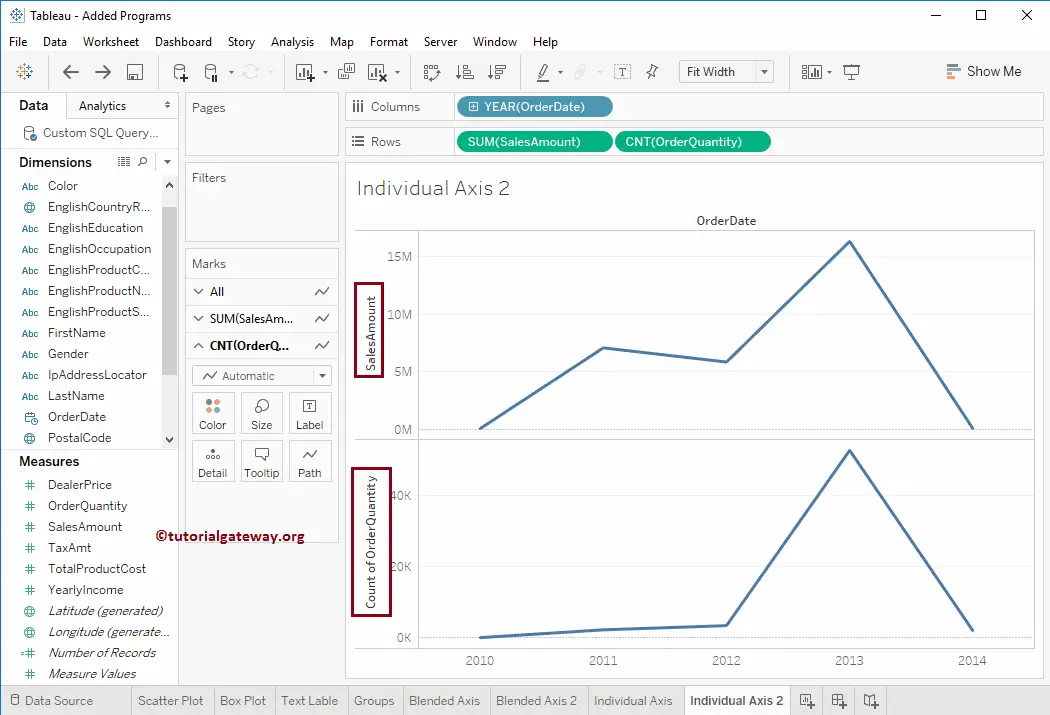
Tableau Text Label
Format Fields and Field Labels - Tableau Right-click (control-click on Mac) the field label in the view and select Format. In the Format pane, specify the settings of the font, shading, and alignment field labels. Note: When you have multiple dimensions on the rows or columns shelves, the field labels appear adjacent to each other in the table.

Viz Forever — How to Create Dynamic Labels in Tableau
Tableau Essentials: Formatting Tips - Labels - InterWorks Click on the Label button on the Marks card. This will bring up the Label option menu: The first checkbox is the same as the toolbar button, Show Mark Labels. The next section, Label Appearance, controls the basic appearance and formatting options of the label. We'll return to the first field, Text, in just a moment.
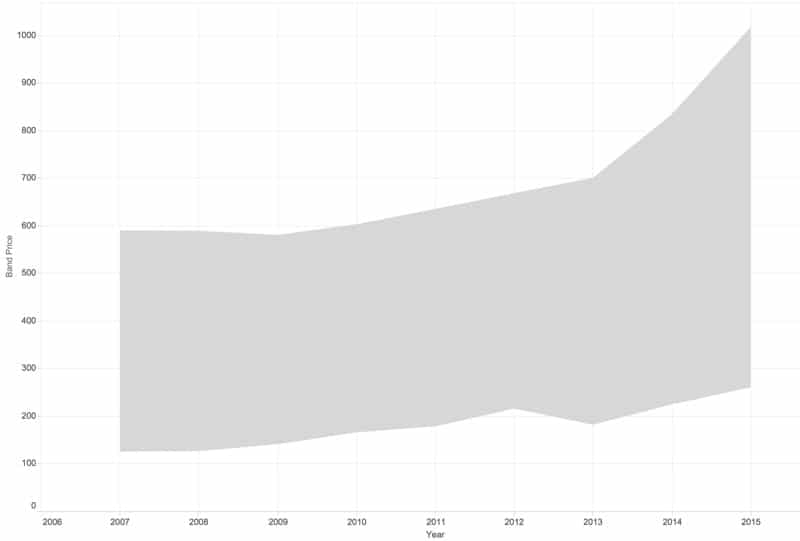
Multi-line chart with custom range banding in Tableau - Ben Collins
Tableau Confessions: You Can Move Labels? Wow! Wow! Tableau Confessions: You Can Move Labels? Wow! Andy Cotgreave. Technical Evangelist Director, Tableau. January 28, 2016. I was on a call with Zen Masters Steve Wexler, Jeff Shaffer, and Robert Rouse. We were talking about formatting labels, and Robert was saying, "Well, of course, you can just drag the labels around.". "Wait.

Edit Axes - Tableau
Show, Hide, and Format Mark Labels - Tableau In a worksheet, right-click (control-click on Mac) the mark you want to show or hide a mark label for, select Mark Label, and then select one of the following options: Automatic - select this option to turn the label on and off depending on the view and the settings in the Label drop-down menu.

Beyond Dual Axis: Using Multiple Map Layers to create next-level visualizations in Tableau ...
How to assign custom Shapes Axis Labels in Tableau ... create the chart as shown below. Put your measure in column shelf and dimension in rows shelf and the 'Position' calculated field in column shelf for dual axis as shown below. Now right click on the Position calculated field in from the columns shelf and click on the dual axis. After that click on any axis and synchronize the axis.
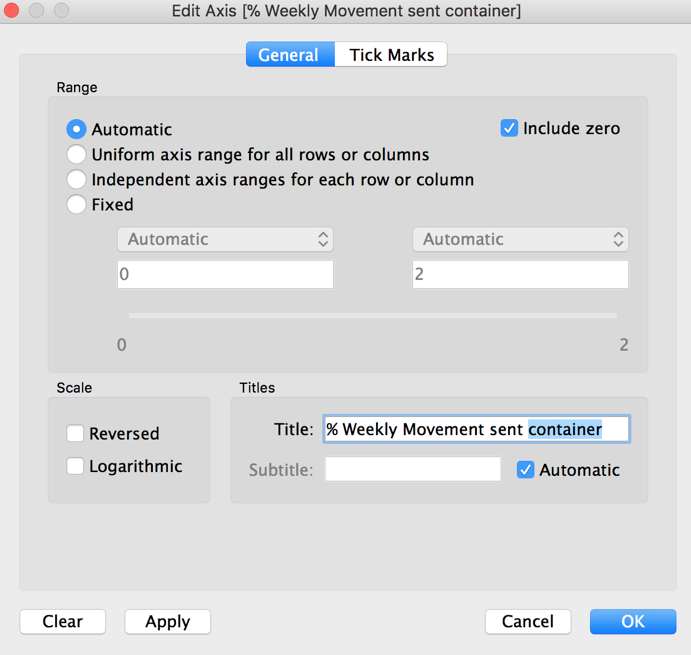
33 Tableau Axis Label On Bottom - Label Design Ideas 2020
Tableau Essentials: Formatting Tips - Custom Shapes ... Now that we've got country-specific marks on each data point, we don't need the x-axis labels any more. Those labels were forcing our table to be larger than necessary for legibility. With the custom symbols, we can create a much more compact table that is still much more visually compelling than using the default symbols.

Tableau Bar Chart Labels On Top - Free Table Bar Chart
changing the displayed labels on a tableau liner graph ... Finally, once you are happy with your chart, you can change the formatting instructions to affect how dates are displayed on the axis. Right click on a number on the axis, choose format, and then in the format pane, under scale you should see a pull down labelled Dates. You can choose one of the existing date formats or enter a custom one.
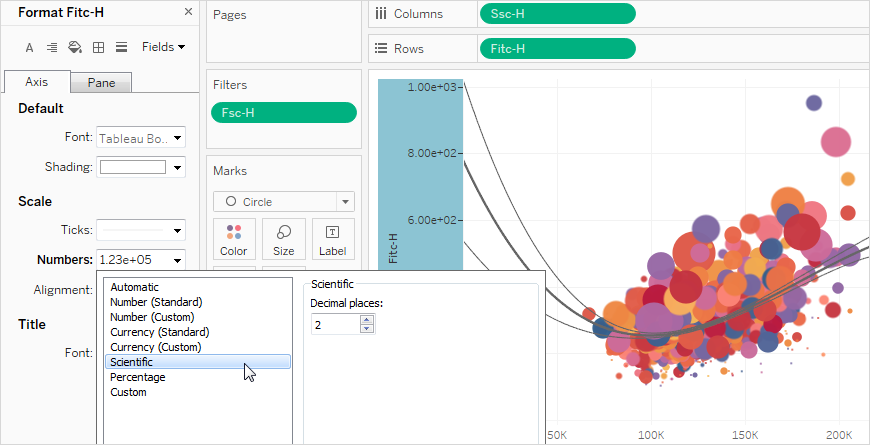
Format Numbers and Null Values - Tableau
Custom Shapes as Axis Labels | Tableau Software Right click the "Custom Shapes" axis and select edit axis. Select the fixed range. Set the range the start to .9 and the end to 1.1. Click ok. Then, right click the x axis and uncheck show header. In the marks card, "Min (Custom Shapes)," select shape from the drop down menu. The shape button should now appear on that marks card.

Tableau Tip: Adding dynamic Top X labels in 9 easy steps (add Bottom X for even more goodness)

Going Dual Axis on Maps | Tableau Public
Add Axes for Multiple Measures in Views
Post a Comment for "42 tableau custom axis labels"